Tradition, Innovation,
and the Future of Learning
Introduction: Why Anatomy Still Matters
Anatomy remains one of the foundational disciplines of medicine. It underpins clinical reasoning, procedural safety, and diagnostic accuracy across healthcare practices. Despite changes in curricula and teaching modalities, its relevance has not diminished. Instead, anatomy education now exists at a pivotal intersection between long-standing tradition and emerging innovation.
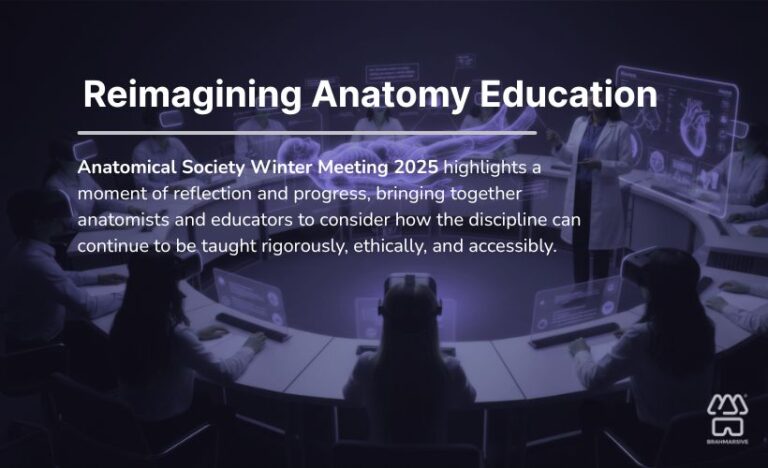
Academic gatherings such as the Anatomical Society Winter Meeting 2025 highlight this moment of reflection and progress, bringing together anatomists and educators to consider how the discipline can continue to be taught rigorously, ethically, and accessibly. The challenge is not whether anatomy education should evolve, but how that evolution can preserve depth while expanding reach.
Tradition and Rigor in Anatomical Sciences
Cadaver dissection has long been regarded as the gold standard in anatomy education, offering tactile engagement and spatial understanding that shape professional identity and clinical competence. Research continues to affirm the value of anatomy as a cornerstone of safe medical practice (Turney, 2007).
However, educators increasingly face constraints related to limited lab time, growing student cohorts, and unequal access to physical resources. As Drake et al. (2009) observed, the evolution of anatomy education is driven not by a departure from tradition, but by the need to sustain quality learning within modern educational realities.
Contemporary Challenges: Access, Equity,
and Scale
One of the most persistent challenges in anatomy education is access. Cadaver availability varies widely across institutions and regions, influenced by ethical, financial, and infrastructural factors (McLachlan et al., 2004). These disparities can limit learning opportunities, particularly for institutions with constrained resources.
Additionally, anatomy is inherently three-dimensional. Students often struggle to translate two-dimensional representations into accurate spatial understanding, especially when exposure is limited to short laboratory sessions (Garg et al., 2001). These challenges have prompted educators to explore complementary approaches that support repetition, exploration, and equity without compromising academic rigor.
From Memorization to Meaningful Understanding
There has been a broader pedagogical shift in medical education toward deeper conceptual learning. In anatomy, this means moving beyond naming structures toward understanding relationships, functions, and clinical relevance.
Experiential learning theory emphasizes that understanding is strengthened through active engagement and reflection (Kolb, 1984). In practice, this requires learning environments that allow students to explore, revisit, and interact with anatomical structures repeatedly rather than relying solely on one-time exposure.
Immersive Technology as a Complementary Solution
Within this context, immersive and digital tools have emerged as valuable adjuncts to traditional anatomy education. Three-dimensional visualization and virtual reality environments offer learners the ability to explore complex anatomy interactively, supporting spatial comprehension and self-directed learning (Nicholson et al., 2006). Immersive student learning with cadavers allows students to gain practice and experience before entering a lab, making these real situations even more impactful when engaging them with anatomical concepts.
Modern immersive platforms are increasingly designed to reduce barriers of cost, complexity, and technical expertise, allowing institutions to scale anatomy education without replacing established teaching methods. For example, cloud-based immersive systems now enable learners to access lifelike digital anatomy anytime and anywhere, offering unlimited, repeatable exploration that complements cadaver study rather than competing with it.
Brahmarsive’s Role in Addressing These Challenges
Brahmarsive’s approach to immersive learning reflects this educator-first philosophy. As a cloud-based VR/XR platform developed with anatomists and medical experts, it is designed to support institutions in delivering accurate, interactive anatomy education at scale.
By providing access to lifelike digital cadavers, full-body systems, and detailed views of organs, muscles, and nerves, immersive platforms can help students build spatial understanding through repeated exploration. Interactive features such as rotating structures, examining cross-sections, and performing virtual dissections allow learners to engage actively with anatomy rather than passively consuming information.
Equally important is accessibility. Platforms that function across locations and devices allow institutions to extend anatomy education beyond physical labs, supporting blended, remote, and revision-based learning models. Multi-user collaborative environments further enable educators to guide learners through shared experiences, reinforcing instruction and discussion even when participants are geographically distributed.
Rather than positioning immersive technology as a replacement for traditional teaching, this model supports educators in preserving rigor and enriching learning while addressing challenges of access, scale, and consistency.
Evidence from Healthcare and Clinical Education
The educational value of immersive learning extends into clinical and professional training. Research has demonstrated that virtual training environments can improve procedural performance and support skill transfer in healthcare education (Seymour et al., 2002).
More recently, a systematic review and meta-analysis found that virtual reality-based education consistently improved knowledge acquisition, skill performance, and learner satisfaction across healthcare disciplines (Sung et al., 2024). These findings reinforce the role of immersive tools as effective complements within structured educational frameworks.
Beyond outcomes, time efficiency has become an increasingly important consideration for institutions managing constrained curricula and growing learner cohorts. An independent Total Economic Impact™ study conducted by Forrester Consulting found that organizations using immersive VR training reduced learning and training time for knowledge-based learners by up to 50%, largely due to increased time on task, on-demand access, and the ability to repeat complex procedures without logistical constraints (Forrester Consulting, 2025).
While conducted across enterprise and professional training contexts, these findings are highly relevant to anatomy and medical education, where efficient use of limited instructional time can directly influence depth of understanding, learner confidence, and curriculum sustainability.
Looking Ahead: Blended, Accessible Anatomy Education
The future of anatomy education is unlikely to be defined by a single method. Instead, it points toward blended ecosystems that integrate traditional instruction with digital and immersive tools. Priorities moving forward include preserving ethical standards, supporting educators with flexible teaching resources, and expanding access to high-quality anatomy education globally. Not only are Institutions introducing students to new ways of looking at medicine with technology but setting up the next generation of medical professions with broader skills to take this industry to another level.
As contemporary educational philosophy suggests, true learning represents a shift from memorization to understanding, integrating intellectual growth with a meaningful connection to practice and purpose (Islam et al., 2022).
Conclusion: Evolution Without Displacement
Anatomy education is evolving without abandoning its foundations. Innovation, when guided by educators and evidence, has the potential to strengthen understanding, equity, and engagement. Platforms such as Brahmarsive illustrate how immersive technology can be thoughtfully integrated to support anatomy education that is accurate, accessible, and scalable, while remaining grounded in academic rigor.
The continued dialogue fostered by events like the Anatomical Society Winter Meeting 2025 reminds us that progress in education comes from collaboration, not disruption. The goal remains unchanged: to help learners truly understand the human body, not merely identify its parts.
Further Reading
- Turney, B. W. (2007). Anatomy in a modern medical curriculum.
- Drake, R. L., et al. (2009). Medical education in the anatomical sciences.
- Nicholson, D. T., et al. (2006). Can virtual reality improve anatomy education?
- Sung, Y.-T., et al. (2024). Effectiveness of virtual reality in healthcare education.
- Forrester Consulting. (2025). The Total Economic Impact™ of Meta Quest: Cost Savings and Business Benefits Enabled by Enterprise Learning and Development. Commissioned by Meta, July 2025.