

Over the course of this series, we have mapped two technologies, examined their real strengths and their genuine limitations, and asked the question that every healthcare education leader should be sitting with: what does it cost to invest in only one?
Issue One established the fundamental difference — VR is an experiential and spatial technology that builds embodied clinical competency; AI is a cognitive and language technology that excels at information, adaptation, and assessment. Issue Two examined the challenges on both sides, and closed on the argument that the business case for each is significantly stronger when the other is present.
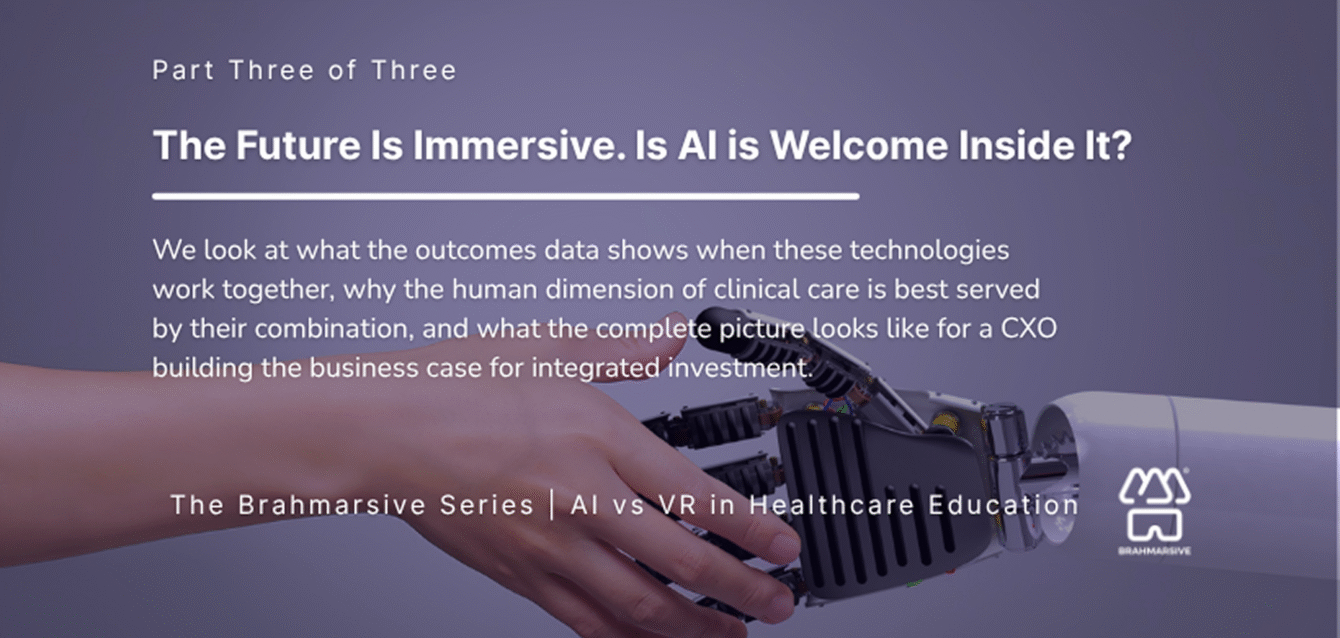
In this final issue, we make that case with the evidence. We look at what the outcomes data shows when these technologies work together, why the human dimension of clinical care is best served by their combination, and what the complete picture looks like for a CXO building the business case for integrated investment.
Immersion as Infrastructure — Not a Modality
The most important reframe for healthcare education leaders is this: VR is not a training modality. It is infrastructure. When built correctly, it is the environment in which learning happens — for anatomy, for procedural skills, for emergency simulation, for communication training, for operational readiness across an entire institution.
Think of it as the room. Once you build the room, AI does not compete with what is inside it — it lifts it. It amplifies and enriches the experience, making the environment more responsive, more adaptive, and more precise. It is the adaptive curriculum that adjusts based on what a learner is struggling with. It is the virtual patient who responds naturally to what a clinician actually says, rather than following a script. It is the analytics layer that tells a department head which scenarios are producing the most errors, and where the curriculum needs to change.
These are powerful additions. They compound the value of the immersive environment significantly. But they do not constitute the environment. And institutions that invest in AI-based tools without building the immersive infrastructure beneath them will find, eventually, that they have a sophisticated analytics layer sitting on top of a learning experience that does not work.
What the Outcomes Evidence Shows
The performance data for immersive simulation is now substantial enough to be definitive for healthcare education purposes. A 2024 systematic review and meta-analysis found that VR-based education consistently improved knowledge acquisition, skill performance, and learner satisfaction across healthcare disciplines (Sung et al., 2024). The BMC Medical Education systematic review found improved academic performance in 86% of included studies, with score improvements of 8 to 31% (Telecan et al., 2025).
When AI is integrated into that environment, the outcomes extend further — and in directions that VR alone cannot reach.
AI-driven learning analytics identify which learners are struggling with which structures, in real time, across an entire cohort. This changes what is possible for curriculum teams. Instead of waiting for assessment results to reveal gaps, faculty see them emerging during simulation sessions — and can intervene before they compound. The personalisation that AI enables does not replace the immersive experience; it makes every session more precisely targeted to the individual learner’s needs.
The Forrester Consulting Total Economic Impact study found that organisations using immersive VR training reduced knowledge-based learning time by up to 50% — driven by increased time on task, on-demand access, and the ability to repeat complex procedures without logistical constraints (Forrester Consulting, 2025). When AI handles the personalisation layer within that environment, the efficiency gains compound further. Faculty time is freed for higher-order educational work. Curriculum teams get actionable data rather than trailing indicators. And learners move through competency development faster, with less waste. But it is worth being explicit about why AI cannot do this alone: the personalisation is only meaningful because the environment exists. There is no adaptive layer without something to adapt within. AI tracks behaviour inside a space, adjusts difficulty within an experience, surfaces gaps revealed through doing. Without the immersive environment, there is no behaviour to track, no experience to adjust, no doing to reveal the gap. The collaboration AI enables is environmental. It depends entirely on VR having built the room first.
The Collaboration That AI Cannot Provide
There is a dimension of clinical education that neither AI alone nor any information technology can address: the human experience of learning together.
Medicine is fundamentally collaborative. Clinical teams think together, act together, and correct each other in real time. The educational environments that produce the best clinicians are the ones that replicate that dynamic — where students and faculty examine, discuss, and reason together around a shared object of study. This is not a soft outcome. It is a documented driver of clinical performance and patient safety.
Immersive platforms extend that collaboration beyond the physical lab in ways that are practically significant. A faculty member can broadcast an anatomy session to 200 students simultaneously, guiding the same exploration for all of them. Groups of 25 can work collaboratively in the same virtual environment, from different physical locations, with the same spatial and experiential fidelity as if they were standing in the same room. Multidisciplinary clinical teams can rehearse high-acuity scenarios together — a pediatric code, a surgical emergency, a sepsis response — whether or not they are in the same building.
AI supports this collaboration — with real-time communication analysis during debrief, adaptive content adjustments for the group, and analytics that reveal team-level as well as individual gaps. But the collaborative experience itself is human. The learning that happens when a resident and a senior clinician explore the same anatomical structure together, challenge each other’s interpretation, and arrive at shared understanding — that is not something AI generates. It is something the immersive environment enables and AI makes more precise.
This is the clearest illustration of why these technologies are not competitors. VR creates the human-centred experience. AI makes it smarter.
The Business Case: People, Process, and the Financial Return
For a CXO building the investment case, the question is never purely clinical. It is whether the investment delivers measurable return across people, process, and financial outcomes — and whether the risk of not investing is clearly understood.
On people: Immersive simulation reduces onboarding time, standardises competency development across large cohorts, and demonstrably improves clinical confidence. These outcomes translate directly to workforce retention — a critical metric in a sector managing significant staff shortages. VR-based training for high-stakes communication skills (breaking difficult news, navigating distressed families, managing error disclosure) produces more confident, more empathic clinicians. That is a people outcome with measurable impact on patient-reported experience scores.
On process: AI-driven learning analytics surface curriculum failures faster than any traditional assessment cycle. Simulation-based emergency rehearsal reduces adverse event rates and improves team preparedness for high-acuity scenarios. VR-based pre-procedure preparation reduces procedure cancellations and sedation rates. These are process efficiency gains with direct operational and financial consequence.
On financial return: The 58% lower per-student cost compared to traditional cadaver programs, the 81.8% ROI modelled across a 300-student cohort, and the 50% reduction in knowledge-based learning time are the headline figures. But the compounding return — content that grows more valuable with every session, curriculum investment that does not walk out the door when a cohort graduates, a training infrastructure that scales with enrolment without proportional cost increase — is the financial argument that endures well beyond the initial procurement.
The Answer to the Question This Series Was Really Asking
We opened this series by suggesting that the institutions getting this right are not choosing between AI and VR. They are understanding what each one does, where each one falls short, and how they fit together.
The evidence supports a clear conclusion: immersive simulation is the foundational infrastructure for clinical education — the experiential, spatial, human-centred environment in which competency is built. AI is the intelligent layer within that environment — adaptive, analytical, and responsive in ways that compound its value significantly.
Neither is optional. An institution that invests only in AI gains information technology without the experiential foundation that produces clinical competency. An institution that invests only in VR gains powerful experiential infrastructure without the adaptivity and analytics that maximise its impact.
The CXO’s question is not which technology wins the budget line. It is: how quickly can we build an environment that has both — and what is the cost, in clinical outcomes and financial return, of the time it takes us to get there?
At Brahmarsive, that is the question we build toward. Immersion first, intelligence layered in — not because we are sceptical of AI, but because we are committed to outcomes. And the outcomes evidence is unambiguous about where the foundation lies. The value of VR and AI as singular entities is real. The value of VR and AI working together is transformational — a combination that neither vendor pitch nor procurement spreadsheet fully captures, but that every institution serious about clinical education outcomes should be building toward.
References
- Forrester Consulting. (2025). The Total Economic Impact™ of Meta Quest. Commissioned by Meta.
- Kissane et al. (2012). Unmet needs in communication skills training across the health professions. Academic Medicine.
- Sung et al. (2024). Effectiveness of virtual reality in healthcare education. Systematic review and meta-analysis.
- Telecan et al. (2025). Systematic review of virtual dissection tables in anatomy education. BMC Medical Education (PMC12492534).
- Kung et al. (2023). Performance of ChatGPT on USMLE: Potential for AI-assisted medical education. PLOS Digital Health.
- INCITEST 2025 Conference Proceeding (DOI: incitest.v1i.858). VR vs cadaver cost/ROI modelling, 300-student cohort.
- Fallowfield et al. (2002). Efficacy of a Cancer Research UK communication skills training model. The Lancet.