

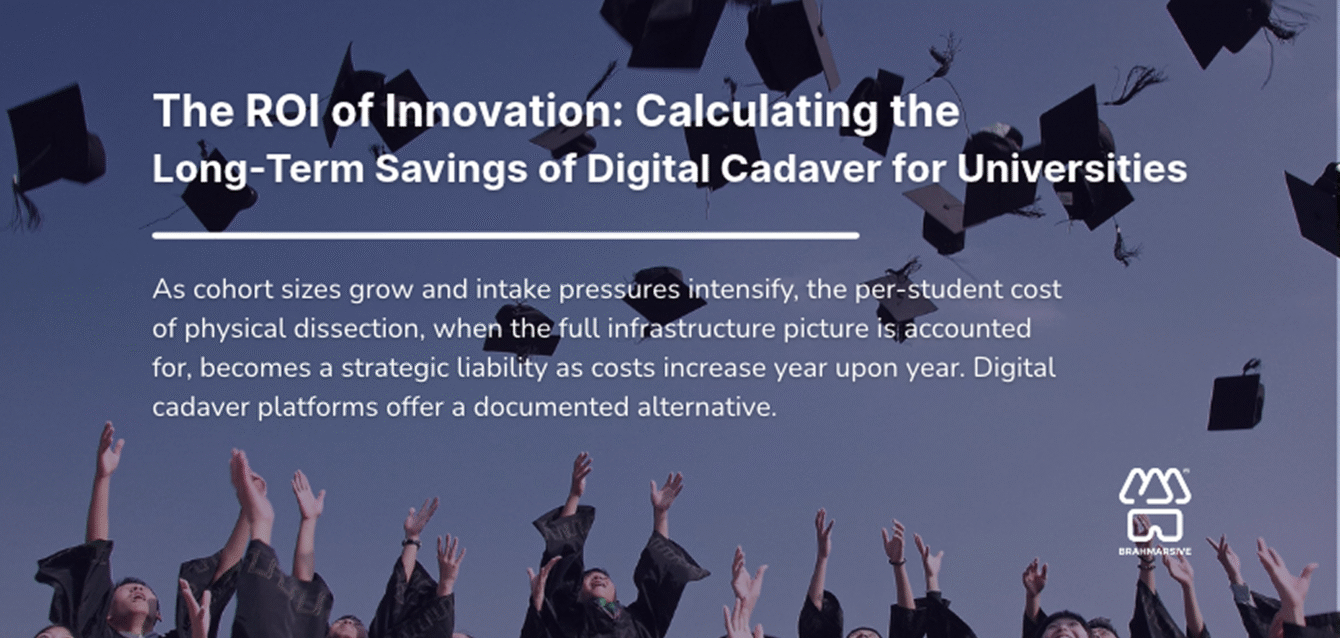
Medical universities running traditional cadaver programs are managing a cost structure that does not scale. As cohort sizes grow and intake pressures intensify, the per-student cost of physical dissection, when the full infrastructure picture is accounted for, becomes a strategic liability as costs increase year upon year. Digital cadaver platforms offer a documented alternative.
The Hidden Costs of Traditional Cadaver Labs
The direct cost of cadaver procurement in the US is typically cited at $2,000–$3,000 per body (Heizenrader). Some market intelligence estimates place comprehensive acquisition costs, including logistics and initial handling, significantly higher, though figures in the $10,000–$20,000 range cited by some sources (Insights10) represent the upper end of reported costs and may reflect specific institutional contexts rather than typical procurement.
Institutions should use their own procurement data as the baseline for ROI calculations rather than relying on third-party estimates at either end of the range. More recent reported figures put the cost of a body at $1,200–$2,000 in a 2023 peer-reviewed paper and up to $5,000 in a 2025 STAT commentary, before the lab around it is counted. Case Western Reserve University completed a gross anatomy teaching-lab renovation in 2025 at a total project cost of $7.3 million (Case Western Reserve University Facilities, 2025), and renovation budgets cover more than cadaver-specific systems.
The ongoing costs that accumulate beyond procurement include:
- Preservation and storage: embalming fluids, refrigeration, specialist ventilation to meet OSHA formaldehyde standards, humidor storage units
- Disposal: regulated and legally compliant disposal of cadaveric remains
- Facility maintenance: climate control, specialised plumbing, rigorous cleaning protocols
- Personnel: specialist lab technicians, safety officers, faculty supervision time
- Limited reuse: specimens degrade and require continuous replenishment as cohorts grow
The pandemic exposed the structural vulnerability of programs without a digital layer. An analysis of anatomy education during August–December 2020 found that cadaver lab use fell from 74.1% pre-pandemic to 50.3% during the pandemic in the US and internationally (Longhurst et al., 2020). Institutions with digital alternatives continued without interruption.
The Digital Cadaver Advantage: A Smart Investment
Digital cadaver platforms require upfront investment in software licences and hardware where needed, but offer a fundamentally different cost trajectory from year two onwards:
- Elimination of recurring cadaver procurement costs: the most direct and significant saving.
- Reduced facility overhead: no specialized infrastructure, only space, IT support, and cloud infrastructure.
- Unlimited scalability: a single platform investment serves hundreds or thousands of students simultaneously, repeatedly, across multiple cohorts and academic years, without degradation.
- Accessibility: students and lecturers access the platform from any location globally, removing geographic constraints and supporting hybrid program models.
- Standardized learning: consistent content quality across every student, unlike physical specimens which vary in condition and anatomical features.
- Institutional knowledge accumulation: content built by faculty stays with the institution and grows in value over time, unlike cadavers which are disposed of.
- Better use of every cadaver session: students who have already explored the anatomy in Digital Cadaver arrive at the lab prepared, so the limited and costly time with real specimens goes further.
What the Numbers Show
The outcomes case for digital anatomy rests on increasingly robust evidence. A 2024 meta-analysis of 24 randomised controlled trials in Anatomical Sciences Education found a moderate and significant effect of VR on knowledge score improvement compared to traditional methods (SMD = 0.58; 95% CI = 0.22–0.95; p < 0.01) (Salimi et al., 2024). This is the highest tier of evidence design — a meta-analysis of RCTs — confirming that the learning gains from digital anatomy tools are statistically robust, not driven by individual study variance.
A Forrester Consulting Total Economic Impact study found that organizations using immersive VR training reduced knowledge-based learning time by up to 50%, driven by increased time on task, on-demand access, and the ability to repeat complex procedures without logistical constraints (Forrester Consulting, 2025).
Calculating Your University’s ROI
The exact return will vary by institution depending on current cadaver program costs and scale. A straightforward calculation framework:
ROI = (Annual savings from reduced cadaver procurement, preservation, storage, disposal, and facility costs × Years) – Cost of platform investment / Cost of platform investment × 100%
Two illustrations show how the inputs differ by country. Both use published figures only; add your own platform quote to complete the calculation.
United States. A program using 24 donor bodies a year (the number reported for one US medical school’s anatomy lab in National Geographic, 2018) spends between $28,800 and $120,000 a year on bodies alone, at $1,200 to $5,000 each (Journal of Neurosciences in Rural Practice, 2023; STAT, 2025). That is before storage, staffing, compliance or the lab itself, and it rises with every increase in cohort size.
India. Under the National Medical Commission norm of one cadaver per ten students, a college admitting 150 students needs 15 bodies. One account in The Federal puts the price of a body procured from the state government at Rs 1.25 lakh, which would put 15 bodies at about Rs 18.75 lakh a year before embalming, storage and staffing. Many colleges cannot reach the norm at all, so for them a digital layer is as much about access as about cost.
For most institutions, the compounding savings from years two onwards significantly outweigh the initial platform investment. The calculation should also account for the resilience value. The cost of program disruption when physical lab access is interrupted is a real risk that a digital layer eliminates.
The Growing Market for Digital Anatomy
Investment in medical simulation is accelerating. Grand View Research values the global medical simulation market at $1.65 billion in 2024, projecting growth to $4.17 billion by 2030 at a CAGR of 16.80% (Grand View Research, 2024). Institutions evaluating digital anatomy platforms now are positioning themselves at the front of a shift that is already well underway. They see the value in investing in VR hardware to teach students more effectively, help them retain complex topics and ultimately deliver better clinicians.
→ Related reading: What Does a Cadaver Actually Cost a Medical School? — Full cost breakdown with sourced figures
Brahmarsive’s Digital Cadaver platform is built for institutional deployment — no-code faculty content creation, broadcast mode for up to 200 students simultaneously, desktop access without headset dependency, and LMS integration.
References
Salimi et al. (2024). Efficacy of virtual reality and augmented reality in anatomy education: a systematic review and meta-analysis. Anatomical Sciences Education, 17(9), 1668–1685. PMID: 39300601.
Longhurst et al. (2020). An analysis of anatomy education before and during Covid-19. Anatomical Sciences Education (PMC8653345).
Forrester Consulting. (2025). The Total Economic Impact™ of Meta Quest. Commissioned by Meta.
Grand View Research. Medical Simulation Market (2024–2030). [$1.65B in 2024; $4.17B by 2030; CAGR 16.80%]
Heizenrader. Why Virtual Cadavers Are a Wise Investment for Medical Schools. [Direct cadaver cost $2,000–$3,000]
Insights10. US Digital Medical Simulation Market for Cadavers. [Note: $10,000–$20,000 figure cited as comprehensive acquisition cost — use own institutional data as baseline]
Case Western Reserve University Facilities (2025). Gross Anatomy Lab Renovation, Robbins Building. [Total project cost $7.3M; completed 2025]
STAT First Opinion (2025, March 31). Medical schools are eliminating the use of cadavers, and that’s a shame. [Whole-body cadaver cost up to $5,000; opinion piece]
Journal of Neurosciences in Rural Practice (2023). Endoscopic neuroanatomy study using embalmed cadavers. 14(2), 377–381. [Cadaver price range $1,200–$2,000]
Newman, C. (2018, December 18). Digital cadavers are replacing real ones. But should they? National Geographic. [24 donor bodies a year at one US medical school anatomy lab]
The Federal. How India’s cadaver crunch is failing future doctors. [Rs 1.25 lakh per body from the state government; one cadaver per ten students norm]