

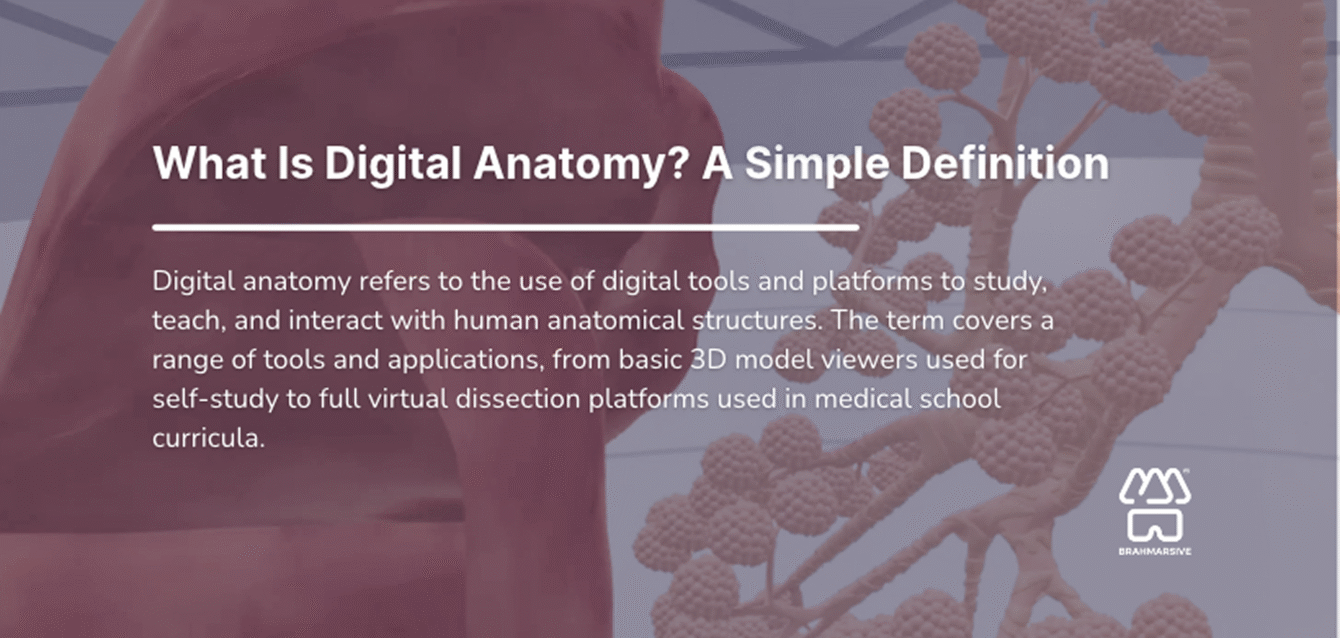
Digital anatomy refers to the use of digital tools and platforms to study, teach, and interact with human anatomical structures. Rather than relying solely on physical specimens or printed atlases, digital anatomy makes anatomical content available in interactive, three-dimensional formats that can be explored on screen, in virtual reality, or through augmented reality overlays.
The term covers a range of tools and applications, from basic 3D model viewers used for self-study to full virtual dissection platforms used in medical school curricula. What they share is the ability to represent anatomical structures digitally, with varying degrees of interactivity and educational depth.
How Digital Anatomy Is Used in Education
In medical and healthcare education, digital anatomy tools serve several distinct purposes:
- Supplementing cadaveric dissection: giving students unlimited access to anatomical structures between lab sessions, without the constraints of specimen availability or lab scheduling
- Teaching spatial relationships: three-dimensional models allow students to rotate, section, and explore anatomy in ways that flat images cannot replicate, supporting the development of spatial reasoning
- Enabling remote and blended learning: digital platforms make anatomy accessible outside of a physical lab, supporting students who cannot always attend in person
- Standardizing content across cohorts: unlike physical cadavers, which vary in condition and presentation, digital models deliver a consistent anatomical reference for all students, helping to cement the fundamentals early in their study.
- Assessment and analytics: modern digital anatomy platforms track how students engage with content, allowing educators to identify knowledge gaps and adjust curricula accordingly
Digital Anatomy vs Traditional Anatomy Education
Digital anatomy is not a replacement for traditional anatomical study. It helps students arrive at the cadaver lab better prepared, so the time spent with a real human cadaver counts for more. The evidence consistently supports a blended approach combining cadaveric dissection with digital tools.
A 2024 systematic review of 24 studies in BMC Medical Education found that VR improved academic progress and learning outcomes in anatomy in the majority of cases, with high satisfaction across participants, when used as a supplementary method alongside traditional approaches (Minouei et al., 2024).
A meta-analysis of 24 randomized controlled trials published in Anatomical Sciences Education found a moderate and significant effect on knowledge score improvement (SMD = 0.58; 95% CI = 0.22–0.95; p < 0.01) (Salimi et al., 2024). The strongest outcomes are associated with programs that use both digital and traditional methods.
What Digital Anatomy Looks Like in Practice
The most capable digital anatomy platforms today go well beyond static 3D models. They allow faculty to build custom learning pathways, conduct live anatomy sessions with large student cohorts simultaneously, and create collaborative environments where students explore the same structures together from different locations.
At the institutional level, digital anatomy software integrates with existing learning management systems, supports compliance requirements, and in the most advanced platforms it gives faculty a no-code content studio to build and update anatomy modules without technical support.
For students, digital anatomy means access to detailed anatomical content on demand with the ability to revisit a structure before an exam, explore a clinical correlation at their own pace, or work through a dissection sequence as many times as needed to build genuine understanding.
Who Uses Digital Anatomy
Digital anatomy tools are used across a wide range of educational and professional settings:
- Medical schools, for undergraduate and graduate anatomy curricula
- Nursing and allied health programs, for foundational anatomy and clinical correlation
- Surgical training programs, for pre-operative planning and procedural rehearsal
- Continuing medical education, for practicing clinicians refreshing or extending anatomical knowledge
- Healthcare simulation centers, as part of broader clinical skills training environments
Brahmarsive’s Digital Cadaver is one example of a dissection-grade digital anatomy platform built specifically for medical education institutions. Brahmarsive’s interactive 3D anatomy platform, is another. If you are exploring digital anatomy solutions for your program, the Healthcare page is a useful starting point.
References
Minouei et al. (2024). Effectiveness of virtual reality on medical students’ academic achievement in anatomy: systematic review. BMC Medical Education, 24, 1407.
Salimi et al. (2024). Efficacy of virtual reality and augmented reality in anatomy education: systematic review and meta-analysis. Anatomical Sciences Education, 17(9), 1668–1685. PMID: 39300601.
Telecan et al. (2025). Systematic review of virtual dissection tables in anatomy education. BMC Medical Education, 25, 1332. DOI: 10.1186/s12909-025-07946-6.
Longhurst et al. (2020). An analysis of anatomy education before and during Covid-19. Anatomical Sciences Education (PMC8653345).