

Table of Contents:
- The Foundation of Traditional Cadaver Dissection
- The Rise of Digital Cadaver and Virtual Cadaver Labs
- Advantages of Digital Cadaver vs Physical Cadaver:
- Challenges of Digital Cadaver vs Physical Cadaver:
- What the Research Says About Digital Cadavers
- Digital Cadavers: The Indian Context
- Conclusion: Bridging the Gap Between Tradition and Technology
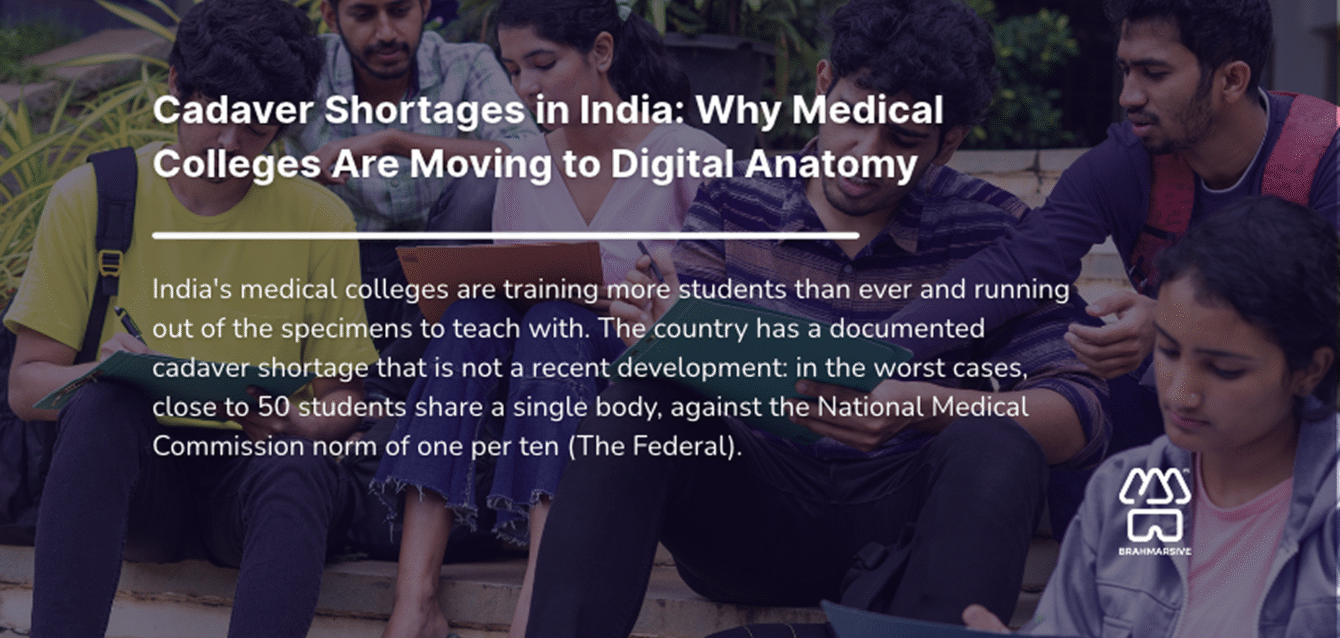
India’s medical colleges are training more students than ever and running out of the specimens to teach with. The country has a documented cadaver shortage that is not a recent development: in the worst cases, close to 50 students share a single body, against the National Medical Commission norm of one per ten (The Federal). Cultural and religious barriers to body donation, combined with the logistical and financial complexity of procurement, have made cadaver supply a persistent constraint for rapidly growing anatomy programs across the country.
MBBS seats have risen 130% since 2014, from 51,348 to 1,18,190 (Ministry of Health and Family Welfare), which means more students sharing a supply that was already short. We look at the same enrolment pressure on US programs, and what it does to cost, in.
For educators and administrators at Indian medical colleges, this is not an abstract resource-planning issue. It is a daily reality that affects what students can access, how often they can access it, and how well-prepared they are for clinical practice.
Digital cadaver platforms are increasingly the practical answer to that constraint. Not operating as a replacement for physical dissection, but as a scalable complement that gives every student consistent, unlimited access to anatomical content regardless of specimen availability.
The Foundation of Traditional Cadaver Dissection
Cadaveric dissection has been the cornerstone of anatomy education for centuries, and its value is not in question. It offers several things that digital tools do not yet fully replicate:
Cadaveric dissection has been the cornerstone of anatomy education for centuries, and its value is not in question. It offers several things that digital tools do not yet fully replicate:
Cadaver shortages
- Ethical and cultural barriers to body donation limit supply significantly. Reporting by The Federal notes that in the worst cases close to 50 students share a single body, against the National Medical Commission norm of one cadaver per ten students.
Cost
- The Genelyn soft-embalming technique used widely in India costs approximately $125 USD per cadaver (THIEME). Additional costs for preservation materials, storage, specialist staff, and disposal accumulate significantly.
Geographic Distribution
- Over 70% of India’s medical colleges are in semi-urban or rural areas, where procurement logistics compound the cost and supply problems.
Health and Safety
- Prolonged formaldehyde exposure raises documented health concerns for students and staff managing dissection labs. Goa Medical College’s 2026 virtual dissection platform is intended in part to address exposure to chemical preservatives such as formaldehyde (Medical Dialogues). India’s Factories Act, 1948 lists a permissible formaldehyde limit of 1.0 ppm (8-hour average), close to the US OSHA limit of 0.75 ppm; OSHA’s formaldehyde standard also sets an action level of 0.5 ppm that triggers exposure monitoring and medical surveillance. Published measurements from Indian anatomy labs remain limited (Journal of the Anatomical Society of India).
The Rise of Digital Cadaver and Virtual Cadaver Labs
Digital cadaver platforms use AR, VR, and high-resolution imaging to create interactive, three-dimensional anatomical learning environments. Unlike physical specimens, a digital model can be accessed by multiple students simultaneously, reset between sessions, and used repeatedly without degradation. Thus, directly addressing the supply constraints that limit Indian medical college anatomy programs.
Advantages of Digital Cadaver vs Physical Cadaver
Accessibility
- Students can access anatomy content from any location, at any time. For medical colleges in remote or rural areas of India with limited cadaver access, this is a meaningful practical advantage.
Cost-effectiveness
- After the initial platform investment, operational costs are minimal. No preservation chemicals, no specialist storage, no regulated disposal. For institutions managing tight anatomy program budgets, the long-term economics favour digital. It also helps students arrive at the cadaver lab better prepared, so the limited number of real specimens, which are costly and hard to source, are used more effectively.
Safety
- No formaldehyde exposure and no chemical handling requirements, reducing health risks for students and faculty.
Interactive Learning
- Digital tools support zooming, rotation, cross-sectional views, and pathology overlays that physical specimens cannot provide. Students can revisit structures as many times as needed.
Unlimited Use
- Digital models maintain consistent quality across every cohort and every session. There is no specimen degradation and no supply ceiling.
Scalability
- A single platform can serve hundreds of students simultaneously, making it suitable for large cohorts that a limited cadaver supply cannot accommodate.
Challenges of Digital Cadaver vs Physical Cadaver
- Tactile feedback: the sensory experience of handling real tissue is not yet fully replicable. Physical dissection retains advantages for developing surgical manual skills specifically.
- Initial investment: platform licenses and hardware require upfront capital. For government-funded institutions with constrained budgets, this can be a barrier, though the long-term cost comparison typically favors digital once the infrastructure is in place.
- Technical dependency: reliable internet connectivity and device access are prerequisites. Implementation planning for rural or lower-resource institutions needs to account for this.
What the Research Shows
A 2025 study published in BMC Medical Education conducted at Sri Ramachandra Institute of Higher Education and Research (SRIHER) in India evaluated VR-based neuroanatomy training across 117 final-year MBBS students. Students who received VR sessions scored higher on the first post-test than those taught with lectures and notes alone (mean 14.1 versus 10.3; p = 0.03), and 98.4% of students with VR exposure completed the three-month follow-up, compared with 58.9% of those without. The authors describe VR as a sustainable adjunct to medical curricula, note that cost remains a barrier, and suggest cloud-based or shared devices as a way to spread the capital cost in resource-limited settings. The study was non-randomised and carried out at a single institution (Kapoor et al., 2025).
A 2025 systematic review in BMC Medical Education — the most comprehensive synthesis of virtual dissection research to date — found improved academic performance in 86% of included studies, with score improvements of 8 to 31% compared to traditional methods alone (Telecan et al., 2025). These outcomes are associated with digital tools used alongside, not instead of, physical dissection.
The Indian Context: Institutions Already Making the Shift
Indian institutions are already making the move. Goa Medical College introduced a 3D virtual dissection platform in 2026 to complement cadaveric dissection, with the aim of easing the limited availability of donated bodies and exposure to formaldehyde (Medical Dialogues, 2026), and SRIHER has published results from a VR neuroanatomy programme (Kapoor et al., 2025). The combination of documented cadaver shortages, a geographically distributed student population, and a large proportion of colleges in areas where procurement is logistically difficult makes India one of the strongest use cases globally for the blended anatomy model.
For Indian medical colleges, digital anatomy is not a premium upgrade to an already-functioning program. It is a practical solution to a supply problem that is not going away.
Conclusion: The Blended Model for Indian Medical Education
The evidence does not support replacing cadaveric dissection. It supports using both — physical dissection where specimens are available, digital platforms to extend access, standardise content, and give every student the repeated practice they need regardless of what the lab can supply on any given day.
For Indian medical colleges managing cadaver shortages, that is not an aspirational position. It is the most practical path to consistent anatomy education at scale.
→ Related reading: What Does a Cadaver Actually Cost a Medical School? — Full institutional cost breakdown with sourced figures
References
Kapoor et al. (2025). Virtual reality — an innovative tool in medical education. BMC Medical Education, 26(1), 49. DOI: 10.1186/s12909-025-08346-6. [117 final-year MBBS students, SRIHER; non-randomised; 98.4% vs 58.9% follow-up completion]
Telecan et al. (2025). Systematic review of virtual dissection tables in anatomy education. BMC Medical Education, 25, 1332. DOI: 10.1186/s12909-025-07946-6.
Longhurst et al. (2020). An analysis of anatomy education before and during Covid-19. Anatomical Sciences Education (PMC8653345).
THIEME. Genelyn soft-embalming technique — cost per cadaver in India (~$125 USD).
University of Glasgow / Public Health Scotland (post-pandemic case report). Blended anatomy learning recommendation.
Government of India, Ministry of Health and Family Welfare. Lok Sabha Unstarred Question No. 697 (29 November 2024). [MBBS seats up 130% from 51,348 before 2014]; Careers360 (2025, April 5), citing ministry data: 1,18,190 seats.
Factories Act, 1948, Second Schedule (Section 41F): Permissible levels of certain chemical substances in work environment. [Formaldehyde: 1.0 ppm 8-hour average; 2 ppm short-term]
OSHA Formaldehyde Standard (29 CFR 1910.1048). [PEL 0.75 ppm 8-hour average; STEL 2 ppm; action level 0.5 ppm]
Journal of the Anatomical Society of India. Estimation of formaldehyde levels in indoor air of gross anatomy laboratory. DOI: 10.4103/jasi.jasi_24_24.