

The Middle East is not short of medical ambition. The region is home to some of the world’s fastest-growing medical universities, internationally accredited simulation centres, and healthcare systems investing heavily in workforce development. Countries across the Gulf and Levant have spent decades building infrastructure, expertise, and the institutional will to train world-class clinicians.
When global disruptions make gathering in a room difficult due to conflict, travel restrictions, or wider geopolitical instability, that ambition does not disappear. The students are still enrolled. The curricula still need to be delivered. The educators are still present. The question is not whether to continue; it is how.
This is not a conversation about emergency workarounds. It is a conversation about infrastructure — the kind that the most forward-thinking institutions in the region are already building, and that the current moment makes undeniably urgent.
Access Is an Educational Standard, Not a Contingency
Anatomy education, more than almost any other discipline in medicine, is built around physical presence. The cadaver lab, the dissection table, the shared experience of exploring the human body alongside colleagues; these are not incidental to anatomy education but in fact central to it.
Yet physical presence has always come with constraints: lab availability, specimen supply, scheduling, and geography. For institutions in any region managing disruption, whether temporary or protracted, those constraints compound quickly. Students who cannot get to a lab are not getting an inferior version of anatomy education. They are getting none.
The pandemic gave the global medical education community a sharp lesson in this. A peer-reviewed analysis published in Anatomical Sciences Education found that cadaver lab use fell from 74.1% pre-pandemic to 50.3% during the August–December 2020 period. Institutions that had a digital layer continued teaching. Those that did not were forced to improvise, often without the tools to do so effectively.
The lesson that held then – holds now: access to high-quality anatomy education cannot be contingent on a student’s ability to walk into a specific room on a specific day.
What the Evidence Shows About Distance Anatomy Learning
The case for digital anatomy tools is no longer theoretical. A 2025 systematic review in BMC Medical Education — the most comprehensive synthesis of virtual dissection table research to date — found improved academic performance in 86% of included studies, with score improvements ranging from 8 to 31% compared to traditional methods alone. One study within the review reported a 12.5% higher likelihood of passing for students who used virtual dissection tools.
Student engagement data is equally consistent. A cross-sectional study of 111 students using a virtual dissection table for thorax anatomy found that 83.3% felt more engaged with the material, 80.1% reported improved spatial understanding of anatomical structures, and 76.6% preferred the platform over traditional methods for complex regional anatomy.
These are not outcomes achieved by replacing the cadaver. They are outcomes achieved by extending anatomy education beyond the physical lab and giving students the ability to explore, revisit, and master structures on their own schedule, in their own location, without degradation of content quality.
A Forrester Consulting Total Economic Impact study found that organizations using immersive VR training reduced knowledge-based learning time by up to 50%, largely through increased time on task and on-demand access. In anatomy, where spatial mastery depends on repetition, that efficiency is more than convenient; it is an educational advantage.
Collaboration Doesn’t Require Proximity
One of the persistent concerns about distance learning in anatomy is the loss of collaborative experience. In a lab, students reason together around a specimen, challenge each other’s interpretations, and build professional identity through shared inquiry.
Immersive platforms are increasingly designed with this in mind. Multi-user collaborative environments allow educators to broadcast anatomy sessions to large cohorts simultaneously, up to 200 students at once, while also supporting smaller group sessions where students explore the same structures together in real time from different locations and safely pass the scalpel in a virtual environment. These crucial discussions do not have to stop because a lab is physically inaccessible.
As one research analysis puts it, the core advantage of immersive VR in education is its capacity to bring individuals from different locations into a single shared environment, where they can interact, communicate, and engage as if physically present. For a region as geographically diverse as the Middle East, with students and faculty distributed across cities and countries, that capability is a practical necessity.
A Blended Model Is the Standard — Not the Compromise
It is worth being direct about what this argument is not. It is not a case for replacing cadaveric dissection with digital tools. The evidence does not support that, and the anatomy education community has been clear on this point. A post-pandemic case report from the University of Glasgow, published through Public Health Scotland, explicitly recommends a blended approach that combines on-campus cadaveric dissection with a 3D virtual anatomy atlas. Not one or the other, but both together.
The blended model is not a temporary adaptation. It is the direction the field is moving in because it delivers better outcomes, serves more students, and creates the institutional resilience that anatomy programs now require. For medical schools in the Middle East, the current moment makes the case for building that digital layer now, rather than waiting for conditions to stabilize.
Institutions that establish robust digital anatomy infrastructure during periods of disruption do not simply survive that disruption. They emerge from it with a more scalable, more accessible, and more resilient educational program than they had before. One that continues to deliver value long after conditions have returned to normal.
The Investment Case
There is a financial argument here as well. A 2025 conference study modeled the cost comparison between VR-based anatomy education and traditional cadaver programs across a cohort of 300 students. It found that per student costs 58% lower with the VR approach, $206.60 versus $491.70. An 81.8% ROI, and cumulative savings of $85,530 by year two. These are modelled figures, and any budget analysis has its limits. But the directional case is consistent with broader literature.
A digital anatomy platform does not degrade with use. It serves an entire institution across multiple cohorts and academic years. It scales with enrollment. It does not require specimen procurement, specialized ventilation, or regulated disposal. And unlike a cadaver that is used once and then gone, the content created within a digital platform accumulates, building an institutional knowledge library that grows with every session.
For institutions managing constrained budgets alongside disrupted operations, the combination of lower per-student cost and uninterrupted delivery is a compelling one.
What Brahmarsive Enables
Brahmarsive’s Digital Cadaver platform was designed to meet this problem, not as a stopgap, but as a permanent layer of anatomy education infrastructure.
Broadcast mode supports up to 200 students simultaneously. Collaborative mode supports groups of 25 hands-on interactive sessions. Desktop access removes the hardware ceiling entirely requiring no headset for students to access the full content library. Students anywhere with an internet connection can explore detailed anatomical models, perform virtual dissections, and engage with the same curriculum as their on-campus peers.
Faculty build and manage content through a no-code studio: creating modules, updating pathways, and developing new anatomy experiences without technical support. The content ecosystem grows with every session, retaining institutional knowledge and curriculum investment over time. The platform complements existing LMS infrastructure and is designed to support FERPA compliance.
The result is an anatomy program that does not stop when access to the physical lab is interrupted because it was never entirely dependent on the physical lab in the first place.
The Conversation Worth Having Now
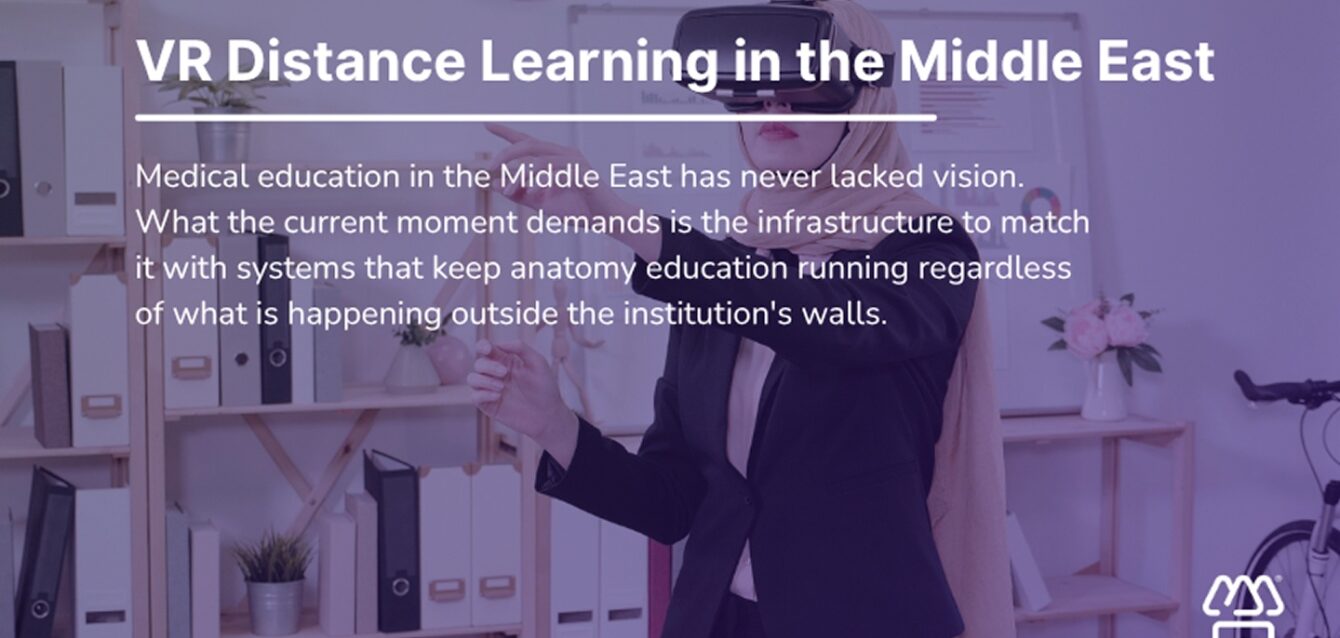
Medical education in the Middle East has never lacked vision. What the current moment demands is the infrastructure to match it with systems that keep anatomy education running regardless of what is happening outside the institution’s walls.
Distance should not mean disconnected. And for institutions ready to ensure it doesn’t, the tools already exist.
If your institution is navigating this moment and looking at how to maintain continuity and quality in anatomy education, we’d welcome the conversation.
References
Longhurst et al. (2020). An analysis of anatomy education before and during Covid-19 (Aug–Dec 2020). Anatomical Sciences Education (PMC8653345).
Telecan et al. (2025). Systematic review of virtual dissection tables in anatomy education. BMC Medical Education (PMC12492534).
Journal of Ilam University of Medical Sciences (2025). Cross-sectional study, n=111, thorax virtual dissection table.
University of Glasgow / Public Health Scotland (post-pandemic case report). Blended anatomy learning recommendation.
INCITEST 2025 Conference Proceeding (DOI: incitest.v1i.858). VR vs cadaver cost/ROI modelling, 300-student cohort.
Forrester Consulting. (2025). The Total Economic Impact™ of Meta Quest: Cost Savings and Business Benefits Enabled by Enterprise Learning and Development. Commissioned by Meta, July 2025.