

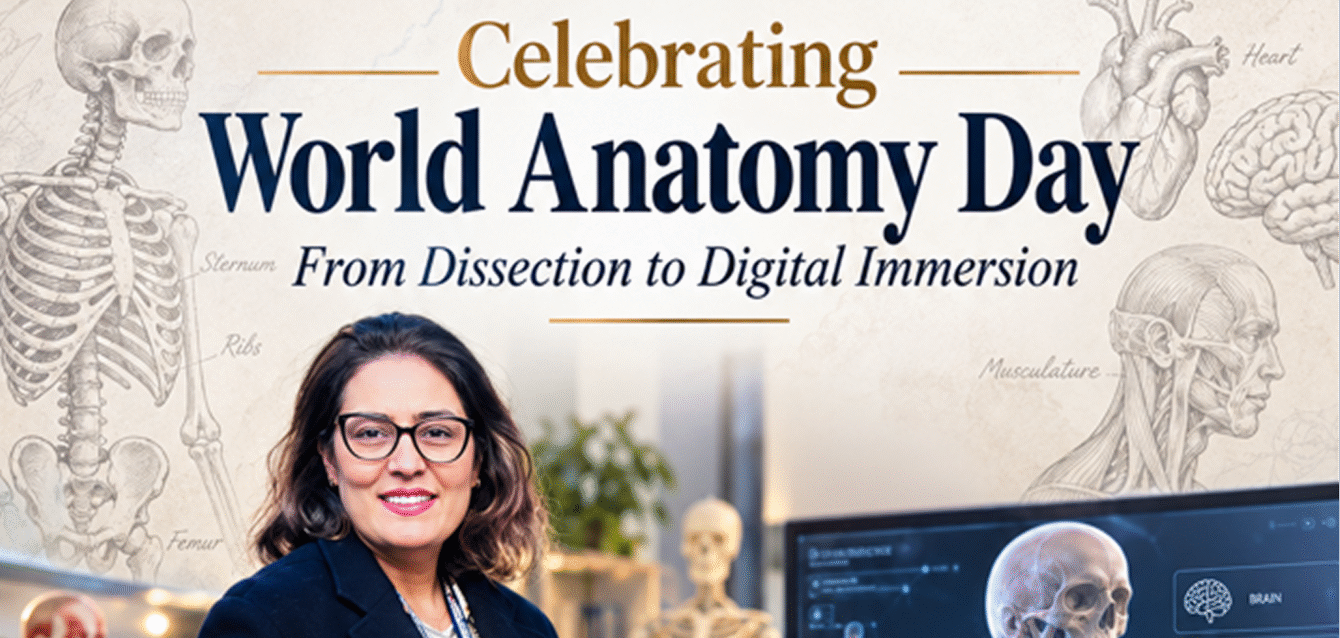
A World Anatomy Day reflection on curiosity, immersive learning and the future of anatomical education
By Dr Shazia Iqbal
University of Buckingham UK
Every anatomy teacher recognises the moment. A student can identify the chambers of the heart perfectly on a labelled diagram, explain the route of blood through the circulation and perhaps even reproduce the anatomy from memory. Then the same heart is rotated, viewed from another angle or presented within a clinical image, and suddenly the certainty disappears. The structure has not changed, but the learner’s perspective has. That simple observation captures one of the enduring challenges of anatomy education: knowing anatomical facts is not necessarily the same as understanding anatomy.
As we celebrate World Anatomy Day, observed on 15 October in recognition of the legacy of Andreas Vesalius, it is worth asking whether anatomy education itself is reaching another important turning point. The International Federation of Associations of Anatomists describes World Anatomy Day as an opportunity for the global anatomical community to recognise the continuing importance of anatomy across healthcare and science. Yet perhaps the most fitting tribute to Vesalius is not simply to celebrate what anatomy has become, but to ask where it should go next.
Vesalius transformed anatomy because he questioned the accepted way of learning it. Rather than relying solely on inherited descriptions of the human body, he returned attention to direct observation and dissection. His educational philosophy was remarkably active for its time. He wrote, “I strive that in public dissection the students do as much as possible.” Five centuries later, that sentence feels surprisingly contemporary. We might describe the same principle today using the language of active learning, experiential education or learner-centred pedagogy, but the essential idea has changed very little: students understand anatomy more deeply when they interact with it rather than merely observe it.
That principle becomes increasingly important when we consider the complexity of learning anatomy. Human anatomy is not a flat subject. It is spatial, relational, functional and ultimately clinical. The recurrent laryngeal nerve matters not simply because a student can name it, but because of the route it takes and the consequences of injury. The coronary arteries become clinically meaningful when their anatomical territories are connected with myocardial ischaemia. The brachial plexus stops being a collection of roots, trunks, divisions and cords when a learner is asked to predict the clinical consequences of a lesion at a particular level. Anatomy becomes medicine when structure acquires meaning through relationship, function and consequence.
Traditional approaches remain indispensable, particularly cadaveric dissection, prosection, imaging, models and expert-guided teaching. However, the growing use of virtual reality and extended reality provides learners with something traditional resources cannot always offer: the ability to manipulate anatomy repeatedly, explore it from different perspectives and return to difficult structures without the limitations of laboratory schedules or specimen availability. A recent systematic review and meta-analysis of immersive virtual reality and augmented reality in anatomy education found that these technologies can support anatomy knowledge acquisition and are generally perceived positively by learners, although their educational value depends on how they are integrated into teaching rather than on the technology alone. Other systematic reviews similarly suggest that virtual reality can enhance anatomy learning when used as a supplementary educational method rather than as a simplistic replacement for established approaches.
This is precisely where platforms such as Brahmarsive’s Digital Cadaver Lab become interesting from an educational perspective. The platform enables learners to explore complete anatomical systems through virtual dissection, rotate structures in three dimensions, move through anatomical layers, repeat dissections and access content through virtual reality, extended reality or conventional desktop devices. It also allows guided and collaborative learning experiences. Its Anatomy 360 environment extends that experience by enabling learners to zoom, rotate and explore anatomical systems and organs spatially. The significance is not simply that anatomy can now be displayed digitally. Three-dimensional models have existed for years. The more important educational question is what happens when a learner can actively manipulate anatomy, return to the same structure repeatedly and investigate relationships from perspectives that would otherwise be difficult to access.
Imagine, for example, a learner studying the brachial plexus. On a textbook page, the plexus can initially appear as an intimidating diagram of intersecting lines. Within an immersive environment, however, the learner can rotate the structure, trace individual nerves, view their relationship with surrounding anatomy and repeatedly reconstruct the pathway. That experience may strengthen spatial understanding. But an even more important question remains: does seeing more necessarily mean understanding more?
This is where the emergence of Generative Artificial Intelligence makes the conversation particularly exciting. The rapid development of Generative AI has already begun to influence undergraduate medical education. Current literature describes potential roles for GenAI in personalised learning, explanation, formative feedback, question generation, simulation and educational support, while simultaneously highlighting significant concerns around accuracy, bias, hallucination, overreliance and the need for responsible educational design. Anatomy education itself is now sufficiently engaged with AI that Anatomical Sciences Education has created an evolving virtual issue specifically examining artificial intelligence in anatomical sciences. The real opportunity, therefore, may not be to ask whether AI belongs in anatomy education, but rather what kind of intellectual role we want it to play.
The least interesting application of Generative AI is probably asking it simply to provide another anatomical fact. Students already have textbooks, atlases, search engines and increasingly sophisticated digital resources for that purpose. The more transformative possibility is using GenAI as a cognitive scaffold: not merely supplying answers, but generating questions that force the learner to reason.
Consider the student exploring the coronary circulation in an immersive environment. Instead of simply identifying the left anterior descending artery, the learner could be prompted by an AI-supported tutor: Which regions of myocardium does this artery supply? If it becomes occluded proximally, what functional consequences would you predict? Which ECG changes might follow, and why? How would the presentation differ if the obstruction involved another coronary vessel? The anatomical model provides the visual experience, while carefully designed GenAI scaffolding creates an intellectual conversation around that experience.
At this point, the educational encounter begins to move from identification to interpretation, and from interpretation towards scientific and clinical reasoning. This idea resonates strongly with the Socratic tradition. In Plato’s Apology, Socrates famously argues that “the unexamined life is not worth living.” The importance of Socratic thinking in education is not the quotation itself, but the principle underlying it: knowledge should be examined through questioning. A good teacher therefore does not only ask, What is this structure? The teacher continues: How do you know? Why is it positioned here? What would happen if it were damaged? What evidence supports your explanation? Could another interpretation be possible?
Generative AI has the potential to replicate aspects of this questioning process at scale. Used responsibly, it could function less like an encyclopaedia and more like a Socratic learning partner. Instead of responding immediately with the answer, an AI system could progressively scaffold the learner: offer an initial question, identify a misconception, provide a cue, increase or reduce difficulty and gradually withdraw support as competence develops. Such an approach is particularly relevant to anatomy because anatomical understanding should ultimately support reasoning rather than terminate at memorisation.
This distinction is crucial. If AI continuously removes intellectual difficulty, it risks making learning easier without necessarily making learners better. However, if AI introduces the right intellectual challenge at the right moment, it may help transform difficulty into productive learning. The goal of scaffolding is not permanent support. Effective scaffolding should eventually become unnecessary because the learner has developed greater independence.
In this sense, the future anatomy learner may increasingly move between three interconnected learning spaces. The first remains the physical anatomy laboratory, with its authenticity, variability, professional seriousness and irreplaceable relationship with body donation. The second is the immersive laboratory, where the learner can rotate, isolate, reconstruct and repeatedly explore structures. The third may become a cognitive laboratory, supported by Generative AI, in which learners are challenged to explain, predict, compare, justify and reflect.
These three spaces should not compete with one another. Nor should the question become whether digital anatomy will replace cadaveric anatomy. The more productive question is how each modality can contribute something educationally distinctive. Cadaveric learning offers authenticity and anatomical variation. Immersive technology offers accessibility, repeatability and spatial manipulation. Generative AI may contribute adaptive questioning, feedback and reasoning support. The educator remains central because none of these tools independently provides professional judgement, curricular purpose, mentorship or the human interpretation that gives learning meaning.
That point deserves emphasis because educational technology is often evaluated through the wrong question. We ask whether students liked VR, whether they found a platform engaging or whether they were impressed by a new AI application. These are useful questions, but they are only the beginning. Reviews of immersive technology in healthcare education have shown encouraging learner experiences, while also demonstrating that evidence regarding superiority over other educational approaches remains heterogeneous and that stronger research designs are still needed. The research agenda therefore needs to become more ambitious.
We should ask whether immersive anatomy improves spatial reasoning, whether the learning transfers to unfamiliar clinical problems, whether students retain the knowledge, and whether the technology reduces or inadvertently increases cognitive load. With Generative AI, we should examine whether scaffolding genuinely improves scientific reasoning, whether learners become more self-directed, whether misconceptions are corrected rather than reinforced and, importantly, whether students can ultimately perform effectively when the scaffold is removed.
Those questions reflect another lesson from Vesalius. One of his observations was, “I am not accustomed to saying anything with certainty after only one or two observations.” It is an extraordinarily appropriate warning for contemporary educational technology. Innovation generates enthusiasm quickly. Evidence develops much more slowly. We therefore need to be simultaneously imaginative and critical: willing to experiment with immersive reality and Generative AI, but equally willing to investigate what they actually contribute to learning.
Perhaps that combination of curiosity and scepticism is what connects Vesalius with the modern educator. Vesalius challenged authority by returning to observation. Today’s educators are faced with an almost opposite challenge: we now have access to extraordinary quantities of information and increasingly powerful technologies, but our responsibility is to ensure that learners continue to question what they see and what they are told.
The anatomy classroom of the future may therefore look dramatically different from the anatomy classroom of the past. A learner may stand beside a donor in the dissection room one day, manipulate a virtual body the next and later discuss a clinical anatomical problem with an AI-supported tutor. Yet the deepest purpose of anatomy education should remain surprisingly familiar. We want students to observe carefully, connect structures intelligently, question assumptions, reason from evidence and eventually understand why anatomy matters to the patient in front of them.
On World Anatomy Day, perhaps that is the most important opportunity offered by technology. Virtual reality can help us see the human body differently. Generative AI may help us question what we see more intelligently. But neither should be permitted to replace the curiosity at the centre of learning.
The future of anatomy education should therefore not be defined by how sophisticated our digital bodies become, but by how sophisticated the thinking becomes around them.
A virtual body should never produce a passive mind.
And perhaps the best tribute we can offer Vesalius is to keep doing what great anatomists have always done: look more closely, question more deeply, and remain curious about the extraordinary architecture of the human body.
References and further reading
- García-Robles, A., et al. (2024). Immersive virtual reality and augmented reality in anatomy education: A systematic review and meta-analysis. Anatomical Sciences Education, 17(3), 514-528. https://doi.org/10.1002/ase.2397
- Tyrovolas, S., Leung, A. Y. M., et al. (2023). The effects of immersive virtual reality applications on enhancing the learning outcomes of undergraduate health care students: Systematic review with meta-synthesis. Journal of Medical Internet Research, 25, e39989. https://doi.org/10.2196/39989
- International Federation of Associations of Anatomists. (2025). World Anatomy Day. https://ifaa.net/2025/05/05/world-anatomy-day-2025/
- Brahmarsive. (2026). Digital Cadaver Lab for Medical Students. https://brahmarsive.com/med-students/
- Brahmarsive. (2026). Anatomy 360: Explore the Human Body in Immersive 3D. https://stage.brahmarsive.com/anatomy-360/
- Anatomical Sciences Education. (2024-present). Artificial Intelligence in Anatomy Education: Virtual Issue. Wiley. https://anatomypubs.onlinelibrary.wiley.com/doi/toc/10.1002/%28ISSN%291935-9780.AI-in-Anatomy-Education